A few months ago, a founder messaged us with a question I’ve now heard more times than I can count: “Should I put my whole budget into Reels, or just keep running feed ads like before?” It’s a fair question. The debate around Instagram Reels Ads vs Feed Ads has gotten louder this year because both placements have changed, and so has the way people scroll.
I’ll be upfront: there’s no single winner. But there is a right answer for your business, and that’s what we’ll work out here.
Table of Contents
Why This Question Matters More Than It Used To
Two years ago, most advertisers picked a placement out of habit. Feed was the safe choice, and Reels was the “new thing” you tested with a small budget and forgot about.
That doesn’t work anymore. Instagram pushes video hard, and a big share of time spent on the app now happens in Reels. If your ads only live in the feed, you’re missing a large chunk of attention. If you go all-in on Reels without thinking, you can burn cash on views that never turn into sales.
So the real question isn’t which placement is “better.” It’s which one is better for your goal, your product and your audience.
Instagram Reels Ads vs Feed Ads: How People Actually Behave
Placement matters because the mindset is different in each spot.
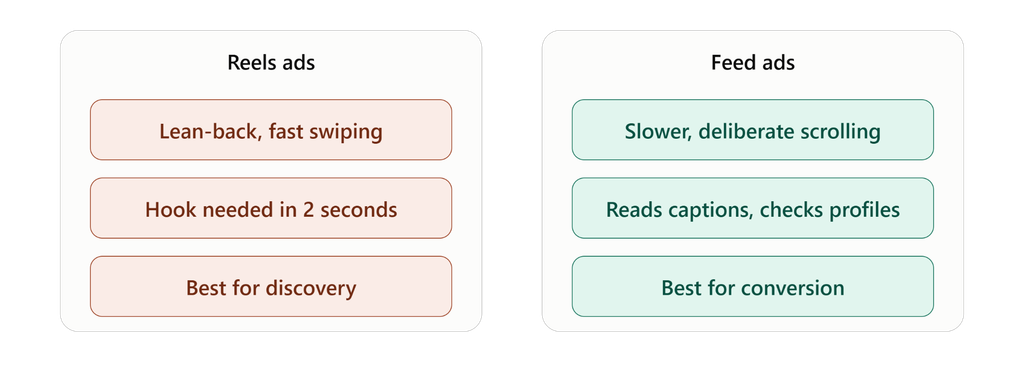
When someone is in Reels, they’re in lean-back entertainment mode. They swipe fast, they want to be surprised, and they’ll give you about two seconds before deciding whether to stay. When someone is in the feed, they’re slower and more deliberate. They read captions, tap into profiles, and compare things.
Think of it like a market. Reels is the busy street performer who pulls a crowd. The feed is the shop counter where people actually ask about prices.
What Reels Ads Do Well
Reels are strong for discovery. If nobody knows your brand yet, they’re usually the easiest way to get in front of new people without paying premium rates. Short, honest, slightly messy videos often beat polished ones here. A founder talking to the camera can outperform a fancy studio shoot, and we’ve seen it happen more than once.
They also suit impulse-friendly products like fashion, food, gadgets and beauty, anything that looks good in motion.
Where Feed Ads Still Win
Feed ads haven’t gone anywhere, and anyone telling you they’re dead is guessing. They still do well for offers that need explaining: higher-priced products, services, courses, B2B, local businesses. Carousels and single images let people take their time, and that patience often shows up as better-quality leads.

Cost, Reach and Results
Instagram Reels Ads vs Feed Ads on Cost and Reach
In most accounts we look at, Reels give you cheaper reach. You get more eyeballs for the same money, which is great for awareness and for filling the top of your funnel.
But cheap reach isn’t the same as cheap customers. Feed placements often show a higher click-to-purchase rate, especially for warm audiences who already know you. The click costs more, but the buyer is usually more serious.
Watch the number that matters to your business, whether that’s cost per lead, cost per purchase or return on ad spend. Don’t get distracted by views. Views feel great in a report and pay no bills.
The Conversion Question
Here’s the pattern that shows up again and again. Reels warm people up, and the feed closes them. A person sees your Reel, shrugs, and scrolls on. Three days later they see your feed ad, remember you, and buy. If you judge Reels only by last-click sales, they’ll look weaker than they really are.
That’s why attribution setup matters so much in 2026. If your tracking is shaky, you’ll make bad decisions and kill placements that were quietly helping you. This is one of the first things our team at Seolizards checks when a new client comes to us frustrated that “Instagram ads don’t work.”
Creative Matters More Than Placement
This is the part most people skip. A bad creative will fail in both places, and a good one can work in both.
Reels need a hook in the first two seconds, captions on screen because most people watch on mute, and a vertical, full-screen format. Feed ads can be a little calmer, with a clear image, a strong headline and a caption that actually says something useful.
Here’s a trick that saves time. Shoot one solid piece of video, then cut it two ways: a fast, punchy version for Reels and a slightly more explanatory version for the feed. When you compare Instagram Reels Ads vs Feed Ads with the same core message, you get a much fairer test than comparing two totally different ideas.
A Simple Way to Decide
Skip the spreadsheets for a minute and ask yourself three things.
- Do people already know my brand? If not, lean on Reels. If yes, lean on the feed.
- How much explaining does my product need? More explaining means feed. Quick and visual means Reels.
- What am I paying for right now, attention or action? Attention points to Reels. Action points to the feed, or a mix.
If you’re stuck between the two, run both. Split your budget roughly 60/40 in whichever direction fits your goal, give it two weeks, and let real data decide. Don’t switch things off after three days. The algorithm needs time to learn.
Mistakes We See Over and Over
Some of these are painfully common:
- Reusing a square feed image as a Reel and wondering why it flops.
- Judging placements after a single weekend.
- Ignoring comments. Replying to them builds trust, and Instagram notices engagement.
- Sending traffic to a slow or confusing landing page. The ad did its job and the website threw the sale away.
That last one hurts the most. Good ads and a weak website are a wasted budget. It’s also why we like to look at the whole journey at Seolizards, from the ad to the landing page to search visibility, because paid traffic works better when your organic presence backs it up. People who see your ad will often Google you before they buy, and you want what they find to be good.
Final Verdict: Instagram Reels Ads vs Feed Ads
So who wins? Honestly, it depends, but here’s my plain-English take for 2026.
Use Reels to get discovered, build audiences and keep costs down at the top of the funnel. Use feed ads to convert, retarget and sell things that need a little more thought. In the debate of Instagram Reels Ads vs Feed Ads, the smartest brands aren’t picking a side. They’re using each one for what it does best and letting them feed each other.
If you’re not sure where to start, or your current campaigns feel like a guessing game, the team at Seolizards can audit your setup and help you build a mix that fits your budget and goals. Sometimes a fresh pair of eyes is all it takes to turn a so-so campaign into a profitable one.
Now go test something. That’s really the only way to know.