If you spend any time inside Customer Match settings, you might want to take a second look this week. Google Ads seems to be quietly testing a new way for advertisers to stretch their first-party audiences further, and it’s called Enhanced Matching. The idea is simple on the surface: use the customer data you already have, and let Google connect it with consented signals from publishers to widen who you can actually reach.
It’s not a full rollout yet, and Google hasn’t made a big announcement about it. But it’s showing up, and it’s worth understanding before it lands in your account.
Table of Contents
What’s Happening in Google Ads Customer Match Settings
A handful of advertisers are spotting a new option tucked into Customer Match, sitting right alongside the account-level controls Google Ads already offers. It’s labeled Enhanced Matching, and from what’s been seen so far, it appears unchecked by default — meaning it’s opt-in, not something forced on you.
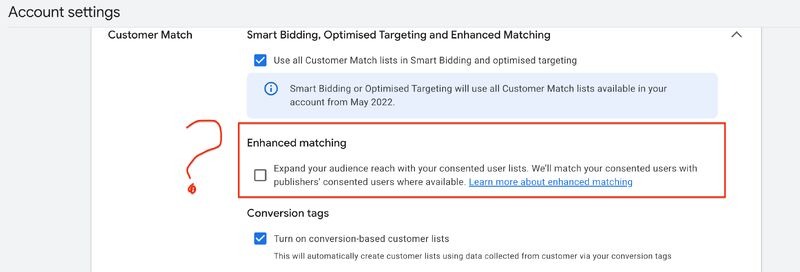
Turn it on, and Google says it will use your connected customer lists to expand reach by matching your consented users against consented users coming from participating publishers. In plain English: your list gets bigger, without you having to go build a second or third list from scratch.
How Google Ads Enhanced Matching Works
Here’s the mechanism as far as we can tell. Google Ads already lets you upload your own customer data — email addresses, phone numbers, whatever first-party info you’ve collected with consent — and use it to find those same people across Google’s properties. Enhanced Matching adds a layer on top of that.
Instead of stopping at Google’s own signals, it reaches into consented data from publishers who are participating in the program. So your existing list becomes the starting point, and the matching process tries to identify overlapping, consented users elsewhere. You’re not adding new data manually. You’re just letting the system look further with what you’ve already given it.
What This Means for Google Ads Advertisers
This matters because Customer Match has always been about one thing: taking the customer relationships you’ve built outside of Google and reconnecting with those same people inside Google Ads. Enhanced Matching doesn’t change that core idea, it just tries to make your existing lists work harder.
For advertisers running lean teams or smaller first-party datasets, that’s a real advantage. You don’t need to spend time and resources collecting more data or stitching together new lists. You just flip a setting and, in theory, your reach grows using the same foundation you already had.
Google Ads Enhanced Matching vs Existing Customer Match Options
Enhanced Matching isn’t showing up alone. It joins a set of tools that already work with Customer Match data inside Google Ads, including:
- Smart Bidding
- Optimized Targeting
- Conversion-based customer lists
So this isn’t a standalone feature competing for attention. It’s another lever sitting next to the ones advertisers already lean on, and it’s designed to plug into the same workflow.
Why Consent Matters in Google Ads
The word “consented” isn’t just a throwaway detail here — it’s doing a lot of work in how Google is describing this feature. Google Ads specifically frames Enhanced Matching as connecting consented users with consented users from publishers. Not just any users. Consented ones, on both sides.
That framing lines up with where the ad industry has been heading for a while now: fewer blanket third-party signals, more first-party data used within clear consent boundaries. Enhanced Matching looks like Google’s attempt to keep audience expansion alive in a privacy-first world, rather than trying to work around it.
What We Still Don’t Know About Google Ads Enhanced Matching
There are real gaps here. Google hasn’t shared how much additional reach Enhanced Matching actually delivers, which publishers are part of the program, or exactly how the matching logic differs from what Customer Match already does on its own.
Availability is also limited right now, which points to this still being early — likely a test running with a small slice of accounts before any wider release. If you don’t see it in your account yet, that’s probably why.
The Bottom Line for Google Ads Advertisers
Enhanced Matching looks like a genuine attempt to make Customer Match audiences more scalable, pairing your consented first-party data with additional consented signals from publishers. If it works as described, it could mean more reach from the lists you already maintain, without extra data collection on your end.
Keep an eye on your Customer Match settings over the next few weeks. Even if Enhanced Matching hasn’t reached your account yet, it’s the kind of feature that’s worth testing the moment it does.