I still remember the first time I ran ads to a completely cold audience. Nobody knew my brand, nobody had heard of the product, and I genuinely thought a decent headline and a “Buy Now” button would do the trick. It didn’t. I burned through half my budget in a week and got exactly two sales. That’s when I actually understood why every business owner talks about a marketing funnel like it’s some sacred formula — because without one, you’re basically asking strangers to marry you on the first date.
If you’re trying to turn people who’ve never heard of you into paying customers, you need a proper marketing funnel — not just an ad and a hope. In this post, I’ll walk you through exactly how I build a marketing funnel that converts cold traffic, stage by stage, with the mistakes I made along the way so you don’t have to repeat them.
Table of Contents
What Is a Marketing Funnel (And Why Cold Traffic Makes It Trickier)
A marketing funnel is basically the journey someone takes from “who even are you” to “take my money.” It usually has four stages — awareness, interest, decision, and action — and each one needs a slightly different approach.
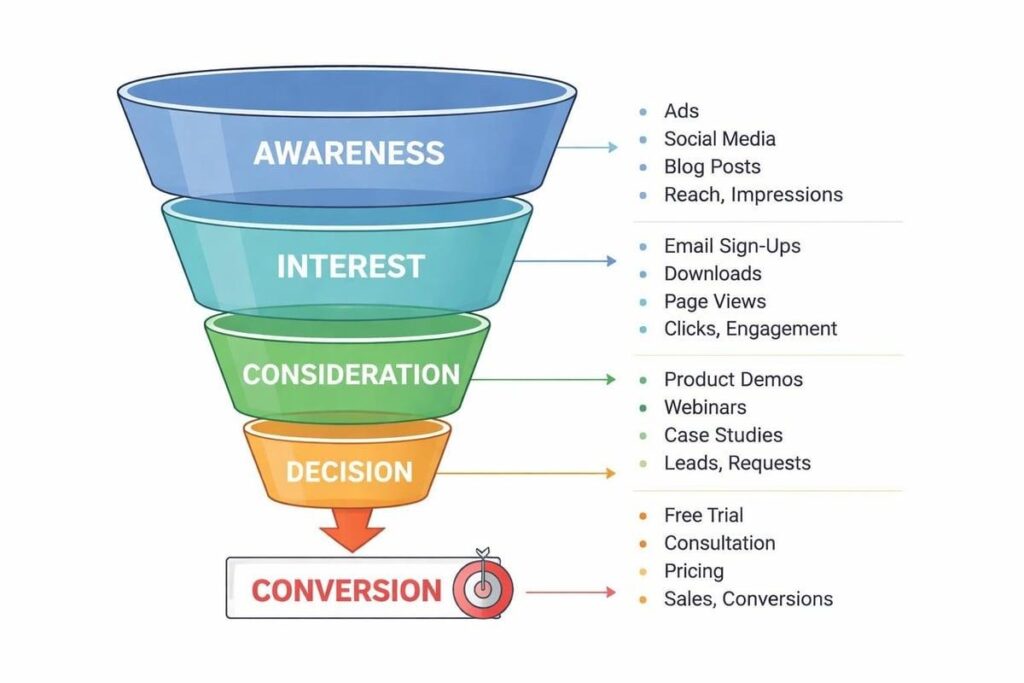
Here’s the thing though: warm traffic (people who already follow you, or came from a referral) skips a lot of the trust-building. Cold traffic doesn’t. They land on your page with zero context and zero reason to believe you. So a marketing funnel built for cold traffic has to work harder at every single stage, especially the first two.
Stage 1: Awareness — Getting Cold Traffic Into Your Marketing Funnel
This is the entry point of your marketing funnel, and honestly, it’s where most people mess up. They try to sell too early. Cold traffic doesn’t want to buy from you yet — they just want to know you exist and that you might be worth their attention.
Choosing the Right Channels for Cold Traffic
Not every platform works the same way for cold audiences. Facebook and Instagram ads, YouTube pre-rolls, TikTok, and SEO content are usually the strongest entry points because they let you interrupt someone’s scroll with something genuinely useful or entertaining. Paid search is a bit different — people there already have intent, so it’s technically “less cold,” but the principle stays the same: earn attention before asking for anything.
A tip I picked up the hard way — don’t send cold traffic straight to a sales page. Send them to something low-commitment: a blog post, a short video, a quiz, anything that lets them dip a toe in.
Creating Scroll-Stopping Content
Your content at this stage needs to do one job: make someone stop for three seconds. That’s it. I’ve found that content built around a relatable problem (“Why does my skin break out every time I travel?”) performs way better than content that leads with a product pitch. People engage with problems before they engage with solutions.
Stage 2: Interest — Building Trust Inside Your Marketing Funnel
Once someone’s noticed you, the marketing funnel shifts into trust-building mode. This is where I see the biggest drop-off, because businesses get impatient and jump straight to “buy now” before anyone actually likes or trusts them.
Lead Magnets That Actually Work for Your Marketing Funnel
A good lead magnet isn’t a generic 10-page PDF nobody reads. It’s something specific and immediately useful — a checklist, a short template, a calculator, a free mini-course delivered over email. The goal is to trade something genuinely valuable for an email address, so you can keep talking to this person even after they leave your website.
Personally, I’ve had way better luck with a 3-step checklist than a 20-page ebook. Nobody wants homework from a brand they just met.
Stage 3: Decision — Nurturing Leads Through Your Marketing Funnel
This is where email sequences, retargeting ads, and case studies come in. At this point in the marketing funnel, the person knows who you are and is quietly weighing you against other options (even if they haven’t said so out loud).
I usually build a 5–7 email sequence here that does three things: shares a quick win, tells a relatable story (often a customer’s), and gently addresses objections — price, trust, “will this actually work for me.” Retargeting ads with a testimonial or a limited-time offer also work really well here, because you’re now speaking to someone who’s already raised their hand once.
Stage 4: Action — Converting Cold Traffic Into Paying Customers
This is the bottom of the marketing funnel, where all the earlier work either pays off or falls apart. A few things that consistently move the needle here:
- Reduce friction. Fewer form fields, clearer pricing, a checkout that doesn’t feel like an interrogation.
- Use urgency honestly. A real bonus expiring or limited spots — not fake countdown timers that reset when you refresh the page.
- Add a risk-reversal. A guarantee, free trial, or easy refund policy removes the last bit of hesitation.
- Follow up on abandoned carts. A surprising number of people who almost converted just need one gentle nudge.
Common Mistakes That Kill a Marketing Funnel
I’ve made most of these myself, so consider this a shortcut:
- Selling too soon. Cold traffic isn’t ready for a pitch in the first five seconds.
- No retargeting. Most people don’t convert on the first visit — ever. Skipping retargeting is like closing the door on 95% of your traffic.
- One-size-fits-all messaging. Cold, warm, and hot leads need different messages. Sending the same email to all three is a fast way to tank your marketing funnel’s performance.
- Ignoring the data. Every stage of your marketing funnel should be measured — click-through, opt-in rate, email open rate, conversion rate. If you’re not tracking it, you’re guessing.
My Final Thoughts
Building a marketing funnel that converts cold traffic isn’t about some clever hack — it’s about respecting the fact that a stranger needs time, proof, and a reason to trust you before they’ll ever hand over their money. Every stage I’ve talked about here exists because I’ve personally watched what happens when it’s skipped: wasted ad spend, low conversions, and a whole lot of frustration.
Start small. Pick one channel, one lead magnet, one email sequence. Get that working before you scale it up. A marketing funnel doesn’t need to be complicated to convert — it just needs to meet people where they actually are.