If you’ve asked ChatGPT or Perplexity a detailed question lately, you may have noticed that the answer rarely comes from a single page. Generative search engines pull from several sources, blend them into one reply, and quietly lean on the sites that seem to really know their subject. That “seems to know” quality is topical authority. I’ll walk through how I’d build it, step by step, without the usual jargon.
Table of Contents
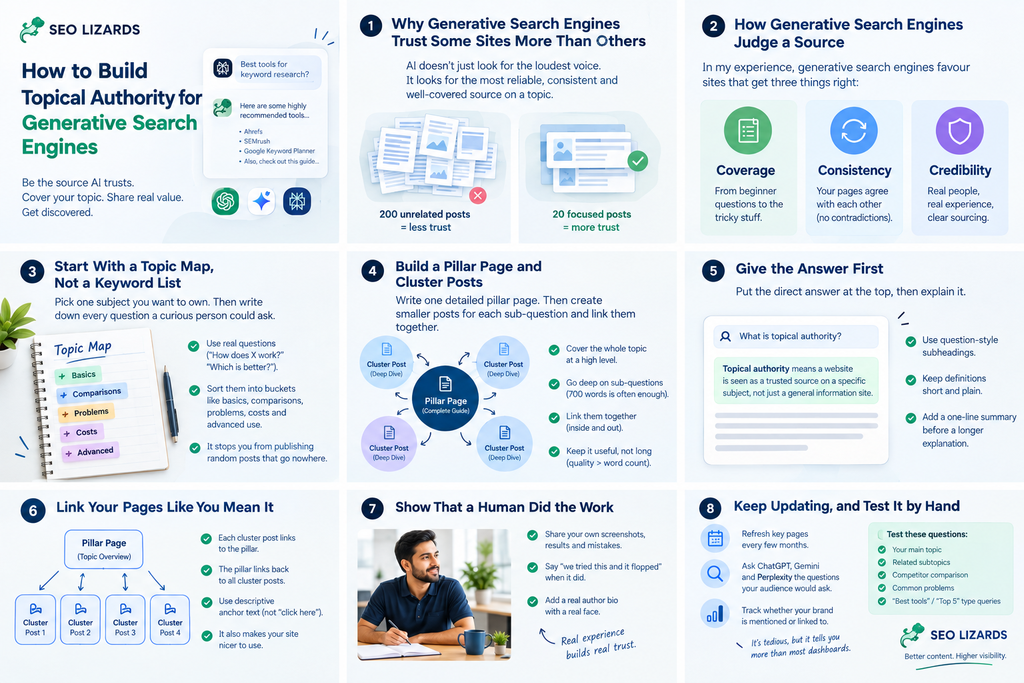
Why Generative Search Engines Trust Some Sites More Than Others
Picture asking around for a good electrician. You’d trust the person everyone keeps recommending over the one who yelled loudest on a billboard. AI-driven search works on a similar instinct. It isn’t counting your posts. It’s looking for a site that keeps turning up as the sensible answer on one particular subject.
That’s why a scattered blog with 200 unrelated articles often loses to a small site with 20 tightly connected ones.
How Generative Search Engines Judge a Source
Nobody outside these companies knows the exact recipe, but in my experience, generative search engines tend to favour sites that get three things right:
- Coverage: you handle the topic from beginner questions to the tricky stuff.
- Consistency: your pages agree with each other instead of contradicting themselves.
- Credibility: there’s a real person, real experience, and clear sourcing behind the words.
Miss one and the whole thing wobbles. Nail all three and things get easier fast.
Start With a Topic Map, Not a Keyword List
Most people open a keyword tool and chase search volume. I’d rather pick one subject I want to own, then write down every question a curious person could ask about it. Write them the way people actually type them into generative search engines: long, a little messy, full sentences.
Then sort them into buckets like basics, comparisons, problems, costs, and advanced use. That’s your map. It stops you from publishing random posts that go nowhere.
Build a Pillar Page and Cluster Posts
Once the map exists, write one thorough pillar page that covers the whole topic at a high level. Then write smaller posts that go deep on each sub-question, and link them back to the pillar.
Don’t pad. If a post says everything it needs to in 700 words, stop at 700. Depth means being useful, not being long.
Give the Answer First
This is the habit most people skip. Put the direct answer at the top of a section, then explain it. Generative search engines can lift a clean, self-contained answer far more easily than one buried under three sentences of warm-up.
A few small things help:
- Use question-style subheadings where they feel natural.
- Keep definitions short and plain.
- Add a one-line summary before a long explanation.
Link Your Pages Like You Mean It
Internal links tell both readers and machines that your pages belong together. Each cluster post should point to the pillar, and the pillar should point back to every cluster post. Use descriptive anchor text, not “click here.” It also just makes your site nicer to use.
Show That a Human Did the Work
This is where small sites can beat big, bland ones. Share your own screenshots, results, and mistakes. Say “we tried this and it flopped” when it did. Put a real author bio with a real face on your posts. Generative search engines can’t verify everything, but content that reads like lived experience is harder to fake and easier to trust.
Keep Updating, and Test It by Hand
Topical authority isn’t a one-and-done project. Refresh your key pages every few months, fix stale numbers, and add new questions as they come up.
Then test it the low-tech way: ask ChatGPT, Gemini, and Perplexity the questions your audience would ask, and note whether generative search engines mention your brand or link to you. Do it monthly and jot down the results. It’s tedious, but it tells you more than most dashboards.
Where SeoLizards Fits In
I’ll be honest: doing this alone is a lot, especially the topic mapping and the ongoing tracking. That’s the kind of work the team at SeoLizards handles every day. They help brands plan topic clusters, write content that sounds like a person wrote it, and build visibility in generative search engines as well as regular search. If you’re stuck or short on time, talking to SeoLizards is a smarter move than guessing.
Final Thoughts
Building topical authority isn’t glamorous. You pick a subject, cover it properly, stay honest, and keep showing up. But that’s exactly what AI-driven search is trying to find: someone who genuinely knows their stuff. Start with one topic, map it out, and publish your first cluster post this week.