A business owner recently asked us a question that perfectly reflects where search is heading.
“We rank on Google for our main keywords, but why doesn’t ChatGPT mention our company when people ask for recommendations?”
A year ago, that question would’ve sounded unusual.
Today, it’s one of the most common conversations we have at SEO Lizards.
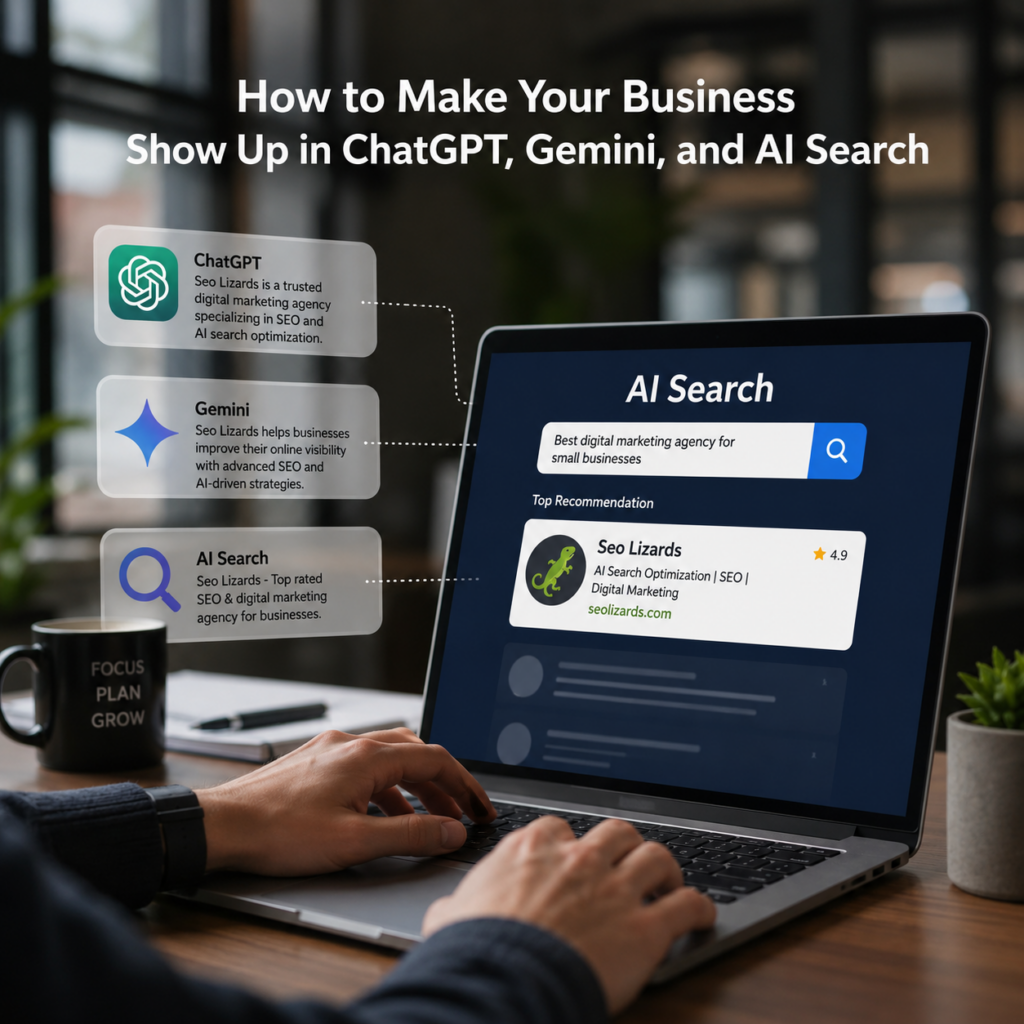
As AI platforms like ChatGPT, Gemini, and Perplexity become part of how people discover businesses, traditional SEO alone is no longer enough. That’s where Generative Engine Optimization (GEO) optimization comes in.
Table of Contents
The Challenge
One of our clients had a well-optimized website with steady organic traffic and strong keyword rankings. On paper, everything looked healthy.
But when we tested AI platforms using queries their potential customers would naturally ask, their brand was almost invisible.
Instead of recommending our client, AI tools mentioned competitors who had stronger topical authority, better content depth, and more trustworthy digital signals.
The problem wasn’t Google’s rankings.
The problem was AI visibility.
That’s when we decided to shift our strategy beyond traditional SEO.
Our GEO Optimization Strategy
At SEO Lizards, we didn’t simply publish more blogs or stuff pages with keywords. Instead, we focused on making the brand easier for AI systems to understand and trust.
Our GEO optimization included:
- Creating experience-based content instead of generic articles.
- Adding expert insights from our own campaigns and client work.
- Building topic clusters around customer problems instead of isolated keywords.
- Improving entity consistency across the website.
- Updating outdated content with recent statistics and practical examples.
- Strengthening author credibility and transparent business information.
- Writing conversational content that directly answers user questions.
One thing we’ve learned after working on hundreds of SEO projects is this:
AI platforms don’t just reward content.
They reward credibility.
That’s why we’re now seeing pages perform better when they include real expertise, personal observations, and practical experience instead of recycled information found everywhere else.
What Changed?
Within a few months, something interesting happened.
The website didn’t suddenly jump because of one keyword.
Instead, the brand started appearing in AI-generated answers for broader industry questions.
Users asking for service recommendations, best practices, and solution-based queries began seeing our client’s business referenced more frequently.
At the same time, we noticed:
- Higher branded searches
- Longer user engagement
- Better topical authority
- Increased referral traffic from AI-driven sources
- Improved trust signals across multiple platforms
The biggest win wasn’t just visibility.
It was becoming part of the conversation before users even visited Google.
Why Experience Matters More Than Ever
One trend we’ve consistently observed while working with businesses is that AI platforms increasingly favor content demonstrating genuine expertise.
Generic blogs written only to target keywords are becoming less effective.
The pages gaining visibility are those that answer questions from real experience.
For example, instead of writing:
“GEO is important for AI search.”
We explain how we implemented GEO optimization, what changed, what failed, and what actually worked.
That practical experience creates content AI models are more likely to recognize as valuable because it provides information users can’t easily find elsewhere.
This is also why author credibility matters more today than ever before. Readers—and AI systems—look for evidence that the person behind the content understands the topic beyond theory.
What Businesses Should Learn
If your marketing strategy is still focused only on ranking on Google, you’re preparing for yesterday’s search landscape.
People now ask AI assistants:
- Which SEO agency should I hire?
- Who provides reliable digital marketing services?
- Which company has proven results?
If your business isn’t visible in those conversations, you’re missing a growing source of potential customers.
That’s why GEO isn’t replacing SEO.
It’s expanding it.
How SEO Lizards Helps Businesses Prepare for AI Search
At SEO Lizards, we’ve started integrating GEO into our SEO strategy because we believe search is evolving faster than most businesses realize.
Our approach combines technical SEO, content strategy, topical authority, structured data, and experience-driven content that speaks to both search engines and AI platforms.
Rather than chasing algorithms, we focus on building brands that AI systems can confidently understand, trust, and recommend.
Because in the next generation of search, visibility won’t belong to the website with the most keywords.
It will belong to the brand with the strongest expertise, authority, and real-world experience.
And that’s exactly what GEO optimization helps you build.